
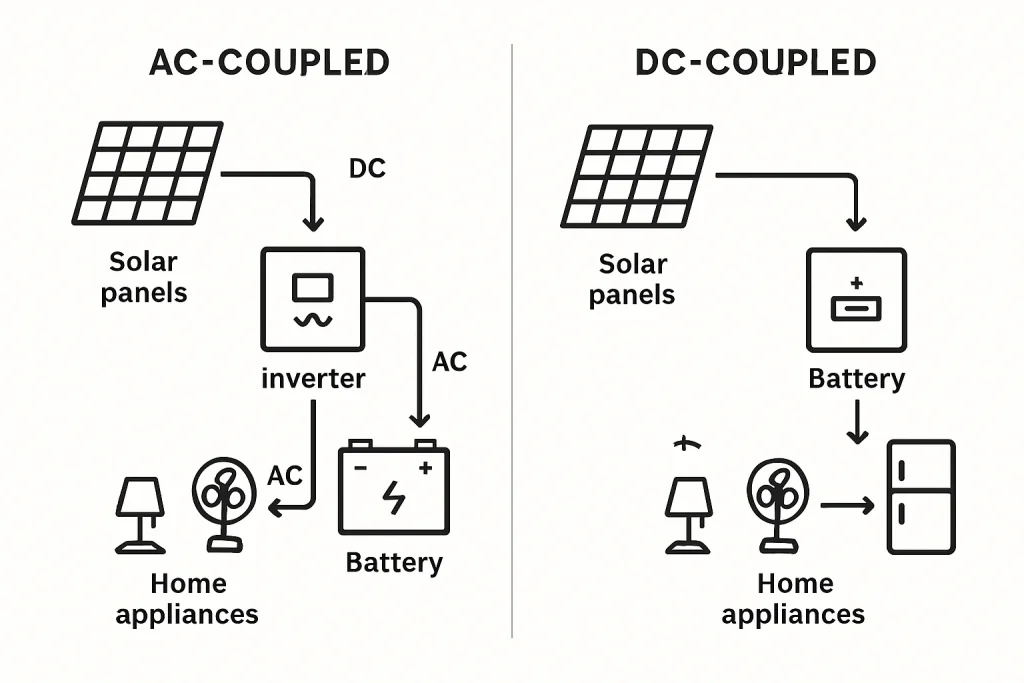
DC coupled systems generally suit new projects where solar and storage are installed together. They convert power fewer times, which makes them slightly more efficient, and they use a single piece of equipment for both jobs.
AC coupled systems generally suit retrofits, where you are adding a battery to solar that already exists. They are more flexible about what equipment they work with and they do not require replacing your inverter.
Neither is better in the abstract. The right answer depends on what is already on your roof.
Why Coupling Exists at All
Solar panels produce direct current. Your home runs on alternating current. Somewhere between the panel and the outlet, that conversion has to happen, and batteries store direct current as well.
Coupling describes where the battery connects relative to that conversion. Connect it on the DC side before conversion and the system is DC coupled. Connect it on the AC side after conversion and it is AC coupled.
That single decision affects efficiency, equipment selection, retrofit difficulty, backup behaviour and cost.
How DC Coupling Works
In a DC coupled system, the solar panels and the battery both connect to a single hybrid inverter, and the panels can charge the battery directly as DC without converting to AC first.
The path looks like this: panels produce DC, DC charges the battery, and power converts to AC only when the house or grid needs it.
What that gains you. Every conversion loses a small amount of energy as heat. Charging the battery directly from DC skips two conversions compared with the AC coupled path, which typically yields a few percentage points of round trip efficiency. Over years of daily cycling that adds up, though it is a modest effect rather than a dramatic one.
It also means fewer boxes on the wall, one manufacturer’s ecosystem, one monitoring platform and one warranty conversation.
The Tesla Powerwall 3 is the clearest example. It includes an integrated solar inverter accepting up to 20 kW of DC input across six MPPT channels. For a new solar plus storage project, the Powerwall 3 is the inverter as well as the battery.
Where DC coupling gets awkward. Retrofitting DC coupled storage onto an existing system usually means replacing or bypassing the inverter you already have, which is more disruptive and more expensive. If your existing inverter is only a few years old and still under warranty, throwing it away to gain a few efficiency points rarely makes financial sense.
DC coupling also ties you more tightly to one manufacturer’s roadmap. If you later want to expand with different equipment, your options are narrower.
How AC Coupling Works
In an AC coupled system, your solar array has its own inverter and the battery has its own inverter. The two systems coexist and coordinate rather than sharing hardware.
The path when charging from solar looks like this: panels produce DC, the solar inverter converts it to AC, the battery inverter converts it back to DC to store, then converts to AC again when discharging.
That is more conversions, and the round trip efficiency is typically a few points lower as a result.
What that buys you. Flexibility. An AC coupled battery does not care much what your solar inverter is. It connects on the AC side, so string inverters, microinverters and most existing equipment can stay exactly where they are. For a homeowner with a five year old array and a functioning inverter, that is decisive.
AC coupling also works for battery only installations, where there is no solar at all. The battery charges from the grid during off peak hours and discharges during peak, which under time of use pricing can still produce savings.
The Enphase IQ Battery 10C is AC coupled with microinverters built into the battery itself, which keeps everything on the Enphase platform. The FranklinWH aPower 2 is also AC coupled and pairs with the aGate controller, which handles the relationship between grid, battery, backed up loads and a generator if one is present.
Where AC coupling costs you. The efficiency difference, modest but real. Sometimes more equipment on the wall. And in some configurations, more complex coordination during an outage, since two inverters have to agree about what is happening.
The Efficiency Difference in Perspective
DC coupled systems typically show round trip efficiency a few points higher than AC coupled ones. It is a genuine advantage and it is worth having when the choice is free.
It is also not worth paying thousands of dollars to obtain. If capturing a few percentage points requires replacing a working inverter, the equipment cost will outrun the efficiency gain for a very long time. Efficiency is a tiebreaker, not a deciding factor.
Backup Behaviour
Both approaches can support backup, but neither does it on the battery alone. Backup requires switchgear that disconnects your home from the grid during an outage, and each platform has its own: a Tesla Gateway or Backup Switch, an Enphase IQ System Controller, a FranklinWH aGate.
One practical difference worth knowing. During an extended outage, a DC coupled system can generally recharge from solar in a fairly direct way. AC coupled systems can also recharge from solar during an outage, but the coordination between the solar inverter and the battery inverter has to be configured correctly. This is standard work for an experienced installer and a common source of disappointment when it is not done properly. Ask specifically whether your system will recharge from solar during a multi day outage.
Which One Fits Your Situation
You are installing solar and a battery at the same time. DC coupled deserves first consideration. Fewer conversions, fewer components, one ecosystem. Confirm that the single unit can deliver the power output your home needs.
You already have solar and want to add storage. AC coupled is usually the practical choice. Your existing array and inverter stay in place and the project is simpler.
You already have Enphase microinverters. An AC coupled Enphase battery keeps everything on one platform, one app and one support path.
You want a battery without solar. AC coupled. There is no solar DC to couple to.
You need very high power output for heavy loads. Look at continuous power and motor start rating before you look at coupling. Architecture matters less than whether the battery can start your air conditioner.
You plan to expand later. AC coupled platforms are often easier to add to incrementally.
What Matters More Than Coupling
Homeowners sometimes arrive at this question having read that one type is better, and spend a lot of attention on it. In practice, coupling is usually decided by your existing equipment, and several other factors have a larger effect on whether you are satisfied.
Whether the battery can deliver enough continuous power for your loads. Whether it can start motor driven equipment. Whether the backup scope covers what you actually care about. Whether your electrical panel supports the design or needs upgrading. Whether the installer configured the operating mode correctly for your rate plan. Whether the system recharges from solar during an outage.
Get those right and coupling becomes a detail. Get them wrong and no architecture will rescue the outcome.
Frequently Asked Questions
What is the difference between AC coupled and DC coupled batteries?
DC coupled batteries connect on the direct current side and share an inverter with the solar array. AC coupled batteries have their own inverter and connect on the alternating current side, after the solar has already been converted.
Which is more efficient, AC or DC coupling?
DC coupling is typically a few percentage points more efficient because power is converted fewer times. The difference is real but modest.
Can I add a battery to my existing solar system?
Usually yes, and it is normally AC coupled. Your existing array and inverter can generally remain in place.
Is the Tesla Powerwall 3 AC or DC coupled? It is natively DC coupled with an integrated solar inverter, and an AC coupled retrofit mode is documented for adding it to existing systems.
Are Enphase and FranklinWH batteries AC coupled?
Yes. The Enphase IQ Battery 10C uses embedded microinverters and the FranklinWH aPower 2 pairs with the aGate controller. Both connect on the AC side.
Do I need to replace my inverter to add a battery?
Not with AC coupling. DC coupled retrofits usually do require replacing or bypassing the existing inverter, which is why AC coupling is more common for retrofits.
Does coupling type affect backup performance?
Both can support full backup with the correct switchgear. The difference shows up in how recharging from solar during an extended outage is configured, which is a design and commissioning matter.
Can an AC coupled battery charge from the grid?
Yes, which allows off peak charging and peak discharging even without solar. Whether that is worthwhile depends on your rate plan.
Let Us Look at What You Already Have
The right architecture usually follows from your existing equipment rather than from a preference. Green Additions installs both approaches and will assess your array, inverter, panel and backup goals before recommending one.

