
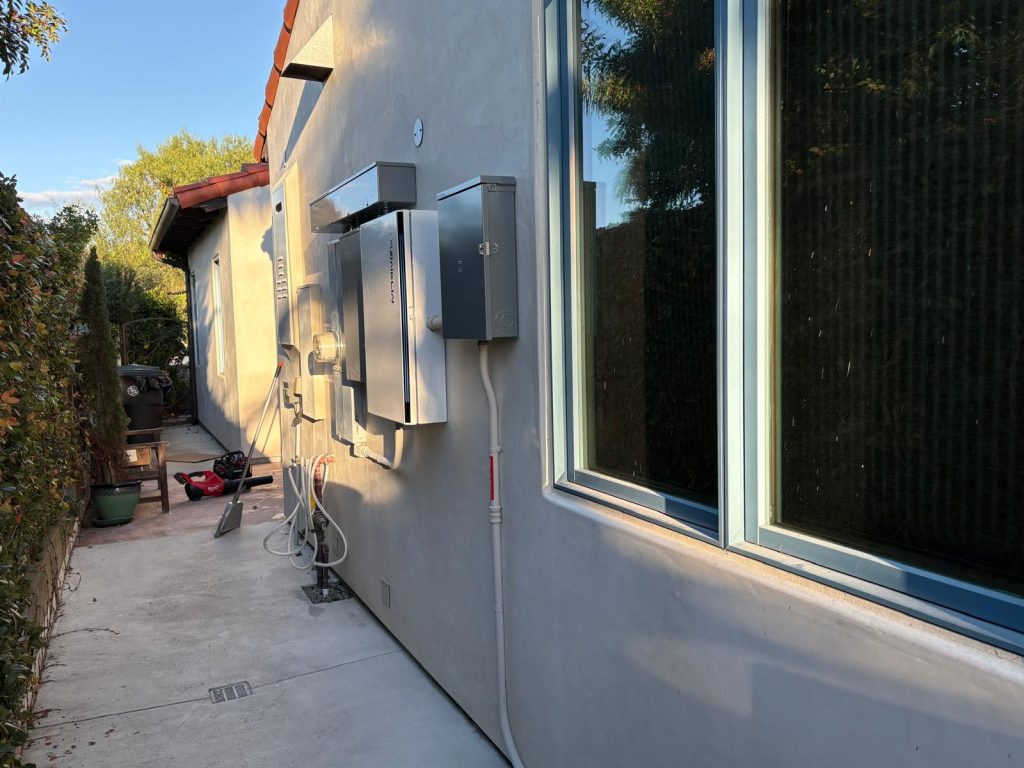
A home battery costs roughly $10,000 to $17,500 installed per unit in Los Angeles in 2026, before incentives. Most homes that want meaningful backup need one or two units, which puts a typical project in the $10,000 to $32,000 range.
Two things to settle before you compare any prices. The 30 percent federal credit that used to apply to home batteries expired on December 31, 2025 and does not apply to 2026 purchases. And whether you can access California’s SGIP battery rebate depends on which utility bills you, which we cover below.
Battery Cost by Model
| Battery | Usable capacity | Continuous output | Estimated installed cost, one unit |
| Tesla Powerwall 3 | 13.5 kWh | Up to 11.5 kW | $13,500 to $17,500 |
| FranklinWH aPower 2 | 15 kWh | 10 kW | $11,000 to $16,000 |
| Enphase IQ Battery 10C | 10 kWh | 7.08 kW | $10,000 to $14,500 |
Estimates reflect 2026 Southern California installed pricing before incentives. Actual cost depends on your site.
A more useful way to compare is cost per usable kWh, which typically lands between roughly $700 and $1,450. That metric normalizes for capacity differences the way price per watt does for solar. It does not capture power output though, so a battery that is cheap per kWh but cannot start your air conditioner has not solved your problem. Our battery comparison guide covers how capacity and power output differ.
What the Money Buys
| Line item | Typical range | Notes |
| Battery hardware | $8,000 to $10,500 | Set by the manufacturer, varies by model |
| Gateway, controller or transfer switch | $1,000 to $1,800 | Required for backup. Tesla Gateway, Enphase IQ System Controller, FranklinWH aGate |
| Installation labor and materials | $1,500 to $4,500 | Mounting, conduit, conductors, varies with distance from the panel |
| Permit and inspection | $300 to $900 | Set by your jurisdiction |
| Backup or load subpanel | $1,500 to $3,500 | When only selected circuits are backed up |
| Main panel upgrade | $2,000 to $4,500 | Only when the load calculation requires it |
| Each additional battery | $8,500 to $11,000 | Unit plus incremental labor. The controller is shared |
Notice how much of this is electrical work rather than the battery itself. That is why a quote built only around hardware price tends to grow later.
What Actually Drives Your Number
Whole home versus partial backup. Backing up selected circuits costs less than backing up the entire house. Whole home backup needs enough continuous power to run everything that might switch on at once, which often means more than one unit, plus the switchgear to manage it. Partial backup uses a subpanel carrying the circuits you choose.
Your electrical panel. This is the most common source of surprise cost in Los Angeles. A large share of the local housing stock is older, and 100 amp service with no available breaker spaces is routine. The load calculation decides whether you need an upgrade, a subpanel or load management.
Heavy loads. Central air conditioning, well pumps and pool pumps draw a large surge at startup. Supporting them during an outage drives battery selection toward higher power output models, which affects cost.
Distance and access. The run between your battery location and your main panel affects conduit, conductor sizing and labor. A battery on the far side of the house costs more to connect than one beside the panel.
Retrofit versus new install. Adding a battery to an existing solar system is usually AC coupled and involves working around equipment that is already there. Installing solar and storage together allows a DC coupled design that can be simpler and slightly more efficient. Our guide to AC coupled versus DC coupled explains the difference.
Number of units. The second battery costs less than the first because the controller, permit and much of the labor are already accounted for.
Incentives in 2026: What Is Real
The federal credit is gone. Section 25D expired December 31, 2025. A battery purchased in 2026 by a homeowner receives no federal residential credit. Treat any calculator applying 30 percent as out of date.
SGIP, the California Self-Generation Incentive Program, is a rebate based on usable storage capacity. The general market tier pays a modest per kWh amount, historically in the range of roughly $150 to $250 per kWh, which on a 13.5 kWh battery works out to a few thousand dollars. Equity and Equity Resilience tiers pay substantially more for income qualified households and for customers in high fire risk areas, and in those cases the rebate can cover a large share of the project.
Two cautions. SGIP operates in budget steps and availability changes as steps are exhausted, so the program is frequently waitlisted and there is no guaranteed timeline or amount. Never treat SGIP as a certainty when deciding whether you can afford a project. Your installer submits the application on your behalf.
The part most Los Angeles articles miss: SGIP is funded through ratepayer charges on the CPUC regulated investor owned utilities and administered through them. That means SCE customers may be eligible and LADWP customers generally are not, because LADWP is a municipally owned utility outside CPUC jurisdiction. If you are inside the City of Los Angeles on LADWP service, check LADWP’s own programs rather than assuming SGIP applies.
Confirm current program status and your own eligibility before counting on any rebate.
Is a Battery Worth the Cost?
It depends on what you want from it, and the two motivations produce different answers.
For bill reduction under net billing, the value comes from a spread. Every kWh you store and use later instead of exporting is worth the difference between the retail rate you avoid paying and the export credit you forgo. With SCE retail near 35 cents and export credits closer to 6 cents, that gap is roughly 29 cents per kWh, and it is wider during the 4 p.m. to 9 p.m. peak. A battery cycling once daily moves a meaningful amount of value across that spread over a year.
For outage protection, the calculation is different and more personal. Refrigeration, medical equipment, a home office, well water and simply not losing a weekend all have value that does not appear on a utility bill. Homeowners who buy a battery primarily for resilience rarely evaluate it on payback alone, and that is a reasonable position.
For LADWP customers, because exports already earn near retail credit, the rate arbitrage case is weaker. The backup case remains just as strong.
Questions to Ask Before You Sign
Ask what happens if the load calculation requires a panel upgrade, and whether that cost is included or quoted separately. Ask whether the quote covers whole home or partial backup, and exactly which circuits. Ask whether the battery can start your specific air conditioning compressor. Ask who submits the SGIP application and what happens if the rebate does not come through. Ask what the warranty covers, for how long, and what capacity retention is guaranteed at the end of the term. Ask whether the price assumes financing, and what the cash price is.
Frequently Asked Questions
How much does a home battery cost in Los Angeles in 2026?
Roughly $10,000 to $17,500 installed per unit before incentives. Two unit systems typically run $20,000 to $32,000.
How much is a Tesla Powerwall 3 installed in California?
Around $13,500 to $17,500 for a single unit including gateway, labor and permitting. A second unit typically adds $8,500 to $11,000.
Is there still a federal tax credit for home batteries?
No. Section 25D expired December 31, 2025 and does not apply to 2026 purchases.
Can I get the SGIP rebate?
It depends on your utility and the current budget step. SGIP is administered through the CPUC regulated utilities, so SCE customers may qualify while LADWP customers generally do not. The program is often waitlisted.
How many batteries do I need for whole home backup?
It depends on your loads rather than a standard number. You need enough continuous power for everything that may run at once and enough capacity to sustain it. A load assessment answers this.
Can I add a battery to solar I already have?
Usually yes. AC coupled batteries retrofit onto most existing systems. Compatibility with your inverter needs checking first.
Does a battery work without solar?
Yes. A battery alone can provide backup and shift grid power from off peak to peak hours, though the savings case is weaker without solar charging it.
How long do home batteries last?
Warranties commonly run 10 to 15 years with defined capacity retention and cycle or throughput limits. Read the actual warranty terms, since they differ by manufacturer.
Get an Itemized Battery Quote
Green Additions installs Tesla, Enphase and FranklinWH storage and quotes the electrical work separately so you can see what is driving the number. We will also tell you honestly whether a battery makes sense for your situation.

